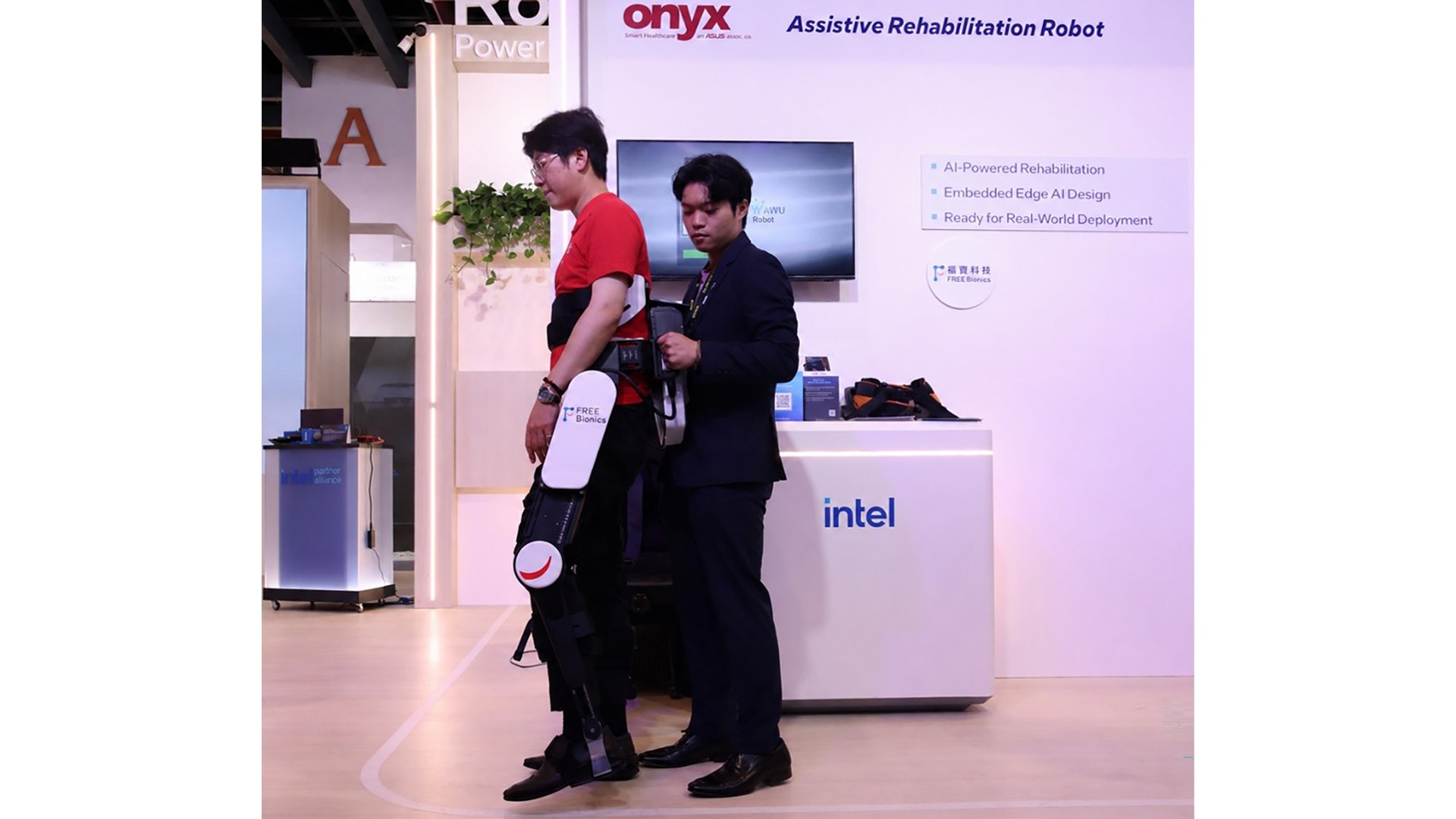
Chips developed at Intel's Hillsboro campus are helping rehabilitation patients with lower-limb injuries relearn how to walk.
The FREE Walk exoskeleton, built by Taiwanese medical device maker Onyx Healthcare and robotics firm FREE Bionics, runs on Intel Core Ultra processors and the company's OpenVINO AI software toolkit.
Intel announced the collaboration Friday, July 17, on its corporate newsroom.
The Core Ultra processor family is developed and refined at Intel's Gordon Moore Park at Ronler Acres, the company's nearly 500-acre global R&D hub for advanced semiconductor technology in Hillsboro.
Intel employs approximately 16,000 workers in Washington County, according to a June 2026 report in The Oregonian.
The practical payoff for hospitals: traditional lower-limb rehab sessions can require up to four therapists per patient. With the AI-powered exoskeleton, that drops by at least two, cutting staffing needs by roughly 50% per session, according to Intel.
Inside the wearable device, the Core Ultra chip's CPU, integrated GPU, and neural processing unit work alongside pressure sensors and electromyography sensors to read a patient's real-time muscle signals and predict the next movement.
The system guides patients through repetitive, controlled limb motions that Intel says reactivate neural pathways and promote neuroplasticity.
"Intel's highly efficient, low-power NPU and OpenVINO software stack really transforms smart rehabilitation from a conceptual showcase on paper into a medical AI solution that is now being used across the world," John Chuang, president of Onyx Healthcare, said in the announcement.
Onyx Healthcare, founded in 2010 and based in Taiwan, has deployed FREE Walk exoskeletons in approximately one-third of Taiwan's major hospitals. The devices have accumulated more than 40,000 patient training records across 22 countries.
Intel executives Alex Katouzian, executive vice president of the Client Computing and Physical AI Group, and Michael Hurley, senior vice president of Silicon and Platform Engineering, appeared at a demonstration event alongside Onyx Healthcare leadership, though neither provided an on-record statement about the product.
Intel's newsroom article did not include a timeline for U.S. availability of the FREE Walk exoskeleton or mention FDA clearance status.