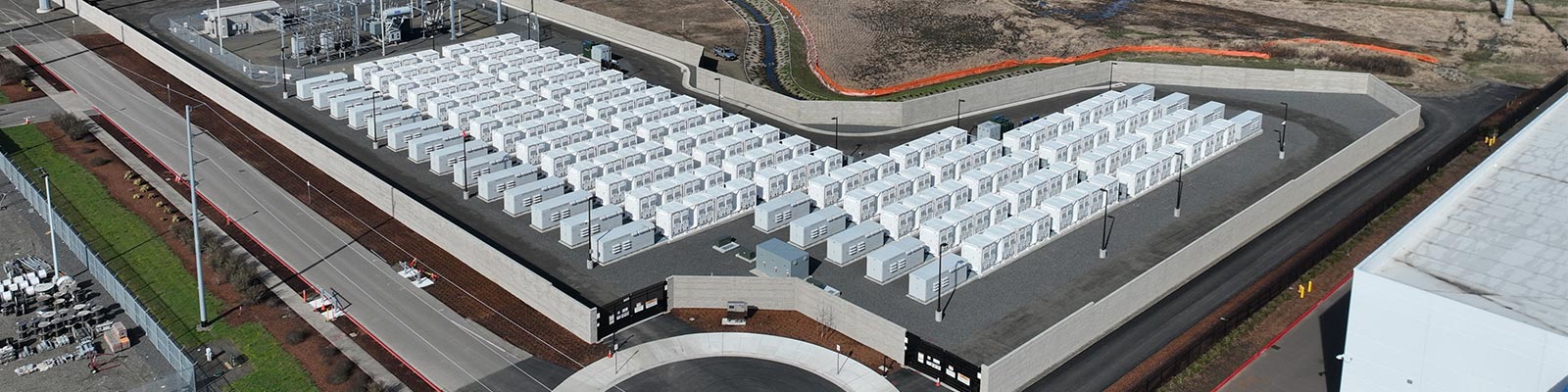
A 31-megawatt battery system being built across the street from Aligned Data Centers' Hillsboro campus is gaining national recognition as a blueprint for how cities can feed power-hungry tech growth without overloading the grid.
The battery energy storage system, a partnership between Aligned, energy specialist Calibrant Energy, and Portland General Electric, would let Aligned's 27-acre, 108-megawatt campus scale up years earlier than traditional transmission upgrades would allow.
It is planned to be operational in 2026. The project lands at a charged moment for Hillsboro. On Monday, July 27, the City Council passed Resolution 2932, a 120-day moratorium blocking new land use applications for data centers and battery storage systems as a primary use.
The Aligned/Calibrant battery predates that moratorium and is classified as an accessory use to the data center, not a primary use. It is not affected by the pause.
How it works
PGE used AI-powered grid planning software from Silicon Valley startup Gridcare to model where data centers could add load without triggering costly, years-long transmission builds. The Aligned battery was the first project to emerge from that analysis.
Canary Media reported the collaboration could unlock 80 megawatts of additional data center capacity PGE will energize next year.
"Those data centers that are willing to work with us, if they're willing to be flexible, we'll put them at the top of the queue for additional power," Larry Bekkedahl, PGE's senior vice president of strategy and advanced energy delivery, told Canary Media.
"For someone who says, 'Nope, we're going to want 100 percent,' well then, we say, 'You'll wait for us to build the transmission.'"
PGE hopes to interconnect 400 megawatts of expanded data center load in Hillsboro by 2029, but Bekkedahl described the battery approach as a bridging strategy while the utility also builds traditional transmission.
Why it matters locally
PGE's data center load in the Hillsboro area grew from 50 average megawatts in spring 2020 to more than 300 average megawatts by the second quarter of 2025, equivalent to powering about 240,000 homes, according to The Oregonian.
The city hosts 470 acres of data center development across 21 sites, and operators received more than $80 million in enterprise zone tax breaks in 2026, per OregonLive's reporting.
The Oregon Public Utility Commission approved a 29% rate increase for PGE's data center customers effective July 8, while residential customers saw an average 1.3% decrease.
Calibrant Energy CEO Phil Martin said in the project's October 2025 announcement that the system "flips the script on how data centers access power" by using distributed energy solutions instead of forcing operators to wait years for upgrades or go off-grid.
National attention, local questions
A panel discussion hosted by Schwabe law firm at the 2026 World Services Group Americas Regional Meeting in Seattle called the Hillsboro project "a first-of-its-kind example of data center flexibility translating from theory into practice." The panel also noted that interconnection timelines for large-scale projects in many U.S. markets stretch five or more years.
The battery uses U.S.-manufactured equipment, safer battery chemistry, built-in fire mitigation, and 24/7 remote monitoring, according to Aligned's press release. The city's moratorium resolution cited fire risk and the absence of BESS-specific development code as reasons for the pause.
Aligned and Calibrant have said they are considering similar projects in other markets. Locally, the next milestones are the Governor's statewide data center task force report due in October 2026 and a Phase 1 land use code amendment targeting a second reading on Tuesday, October 6.